Showing posts with label Urban Planning. Show all posts

Friday, 7 December 2018

Value of Low Carbon Urban Developments

Carbon-intensive urban sprawl
The built urban infrastructure of our cities, the types of residential and commercial buildings, the parking and public transport network, water and electricity networks and delivery mechanisms, will determine the energy use and carbon emissions of a city. Research suggests that roughly 30% of future, “committed” greenhouse-gas (GHG) emissions will occur as a result of new urban building and transport systems. Energy-inefficient urban developments can, therefore, lock us in on a high emissions trajectory. 

Controlling greenhouse-gas emissions from standalone buildings can be achieved relatively easily through better insulation, daylighting, mixed-mode ventilation, more efficient heating and cooling systems, and the installation of small-scale renewable energy sources, particularly on rooftops. Broader strategies, such as achieving optimum urban density, overall building configuration or massing, and urban planning layouts to reduce wastage while ensuring comfort and affordability,  require much more careful analysis and consideration.

Car-dependent urban growth at the fringes of the city, known as urban sprawl, is increasing urban emissions and private transportation energy use. Sprawling, relatively low-density urban settlements make public transportation investments untenable as there are fewer people to the bus or metro service at each transit node. Research has also shown that low urban density can significantly impact urban energy use and the quality of life of urban residentsOn the other hand, dense, mixed-use developments that are close to public transit nodes give people convenient and cleaner transport options. Many cities have mass transit options in place or in the planning stage but are yet to fully adjust urban planning to maximise the benefits. [also see my older blog on Mapping Low Carbon Mobility]
Cities like Buenos Aires have mass transit options in place but are yet to fully adjust urban planning to maximise the benefits.

Towards a greener and more livable urban built-environment
Low -Carbon Green Urban Developments (GUD) can range from smaller projects built around or along with transit stations, i.e., Transit Oriented Developments (TOD), to mixed-use ‘in-fill’ development and ‘green townships’ where transit is incorporated into the masterplan. 

The typical features of these GUDs are:
  • Mixed-use development that includes shops, schools and other public services, and a variety of housing types and prices.
  • High density and compact development to maximise land and improve affordability.
  • More energy, water, and waste efficient design of buildings and infrastructure
  • Public transit stations or transit corridors that are easy to access, reliable, and secure, as well as street and road planning for non-motorized transport.
  • Pedestrian and bicycle friendly street and road planning. Streets should have good traffic calming features to control vehicle traffic speeds.
  • Restriction on car parking to discourage vehicle ownership.
  • Public and private sector participation.
Green Urban Developments provide a more livable urban built-environment

Planning and policy innovations have been critical for green urban development. In Barcelona, superblocks that combine city spaces into pedestrian-friendly, car-free mini-grids have been designed.

Copenhagen has used a “finger plan” an urban plan composed of five well-defined, linear corridors (or “fingers”), separated by green wedges with open spaces, watersheds, and ecological preserves, to drive green growth. Only compact, mixed-use developments were permitted around train stations to ensure a sustainable urban form.

Curitiba created structural corridors to promote job creation and activities away from downtown and inner-city locations and included housing and commercial density around mass transit lanes. As a result, the city has Brazil’s lowest share of car use. The commercial success of Curitiba's urban design and planning has also allowed the city to integrate low-income social housing into these structural corridors using cross-subsidies from market-priced private sector housing.
Copenhagen's 'fingerplanen' materplan developed in 1947

Green Urban Developments create value for all
Developing a reliable transportation system requires large capital expenditure, but a substantial pool of users will offset the costs over time. Decreased pollution and fuel consumption will provide
economic benefits to users, governments, and companies while enhancing a city’s ability to
maintain its competitiveness and environmental sustainability.

Green urban developments can provide substantial cost savings for both city governments and citizens. A recent study concludes that China could save $1.4 trillion in urban infrastructure costs if its urban development plans optimized density over sprawl.

Incorporating transit into urban design allows developers to benefit from stable or higher property values. Mixed-use settings also create commercial opportunities that benefit from increased foot traffic in the area. A developer may also be able to access government incentives for such projects. Hong Kong, for example, has created a financially successful rail and property funding model, allowing the Mass Transit Railway Corporation to partner with individual private developers to build along new and existing rail lines.

Reducing residents’ dependence on private vehicles will help decrease their overall living expenses while improving health outcomes by increasing physical activity. Living in such developments can increase a sense of community and wellbeing for residents and help improve living standards.

A thriving dense mixed-use neighbourhood of HCM City

Making it happen
Both market and policy tools can drive value creation in green urban developments by:
  • Developing a green urban development (or transit-oriented development) policy framework for integrated infrastructure planning that develops sustainable urban growth centres with high-density mixed land use.
  • Reforming land-use regulations such as single-use zoning, low-density limits, and high parking fees to encourage mixed-used, transit-oriented developments with reduced car parking. These should be combined with effective policy changes such as mandating reduced maximum car parking for homes rather than a minimum will also be needed to avoid perverse impacts.
  • Redefining policy definitions of affordable housing to include the combined cost of housing and transport e.g. H+T Index.
  • Creating incentives for the private sector. Cross-subsidization using tax abatement or value capture methods could help make the higher costs of transit-accessible locations less prohibitive for private developers and investors.
  • Exploring alternative implementation options, including Public-Private Partnerships (PPPs), to leverage private sector skills and financing to develop projects.
  • Encouraging corporations to locate offices within green urban developments as an anchor tenant or employer through financial and non-financial policy incentives.

IFC is piloting a new tool to quantify the impact of Green Urban Developments.  The tool is an addition to the array of EDGE tools for green building projects and aims to help developers influence clients to choose “Green Urban Development” designs early in the project planning process. 

Tuesday, 7 August 2018

Green Urban Communities: Are We Ready?

Stockholm has managed to create a highly reliable bicycle system and bicycles have become part of everyday city life.
Cities can be the solution to climate change because their urban density presents a more efficient use of infrastructure and a greener way to live. As they grow, leveraging this advantage, while minimising unintended consequences of pollution and congestion is critical. The right long-term planning and investment choices made by cities now will improve people’s lives, create jobs, improve competitiveness, spur economic growth and mitigate climate change in the future.


Attractive, green urban communities located at public transit nodes can be designed anywhere in the world that combines office, residential and retail use. These mixed-use developments match density to transit capacity, rewarding city-dwellers with less expensive and more environmentally-friendly options while improving their quality of life. Experience has shown that merely providing density adjacent to public transit nodes isn’t enough--Effective policy changes such as, mandating reduced maximum car parking for homes rather than a minimum (which is unfortunately still the case in most cities in emerging markets) will also be needed to avoid perverse impacts.

Urban communities could largely power themselves and It’s possible for adoption to happen virtually overnight. More than a million gleaming solar hot water collectors now decorate the residential rooftops of Rizhao, a city of nearly three million inhabitants located in China’s Shandong province. More than 99 percent of Rizhao households power their hot water and space heating from this renewable energy source. Rizhao has cut its per capita carbon emissions by half compared to a decade ago, and its energy use by one-third.

Vauban Solar Settlement and business park in Freiberg Germany creates more energy than they consume and earn 6,000 euros per year for their residents.
Besides pushing for higher energy efficiency standards in new and existing buildings, cities can be retrofitted with fuel cell-powered cogeneration systems that generate electricity and re-purpose waste heat at the district level. By using high-efficiency, triple-effect absorption chillers, waste heat is supplied to buildings for space heating and water heating or to generate chilled water for air conditioning. Buildings that receive their energy supply from district cogeneration systems don’t require their own HVAC systems or boilers, resulting in efficiencies of up to 40 percent.


Cites in emerging markets have the potential to leapfrog the transit paradigms established in previous centuries by adopting new technologies and business models. Bus rapid transport (BRT), a term that refers to modern bus systems with dedicated traffic lanes, is a great starting point for cities to inexpensively develop a mass transit infrastructure. In Brazil, Curitiba has roughly three and a half times less car travel per person than a car-dependent city such as Brasilia, because of its extensive BRT system. With the drop in battery storage costs, buses can switch to electric to provide more efficient, green and quiet public transportation. With the astronomical rise in car ownership in cities in emerging markets (Number of vehicles in Mumbai up 50% in last 5 years), investment in BRT will have to be complemented by government policies that disincentivise car ownership. [also see my earlier post on Low Carbon Mobility]
Delhi Metro has eased some of the traffic but the city is yet to fully adjust urban planning to maximise the benefits
Most cars in cities sit idle 90 percent of the time or more, hogging space and providing little value. Urban planners can reduce parking spaces, introduce such disincentives as electronic road pricing, and place a quota on car purchases that aren’t electric. This enables alternative bike, scooter and car-sharing programs to sprout, providing a competitive array of accessible options to dart around a city. For example, the motorcycle-sharing service GO-JEK has become a crucial workaround in traffic-clogged Jakarta. Autonomous cars should be approached cautiously, as they may result in greater emissions.

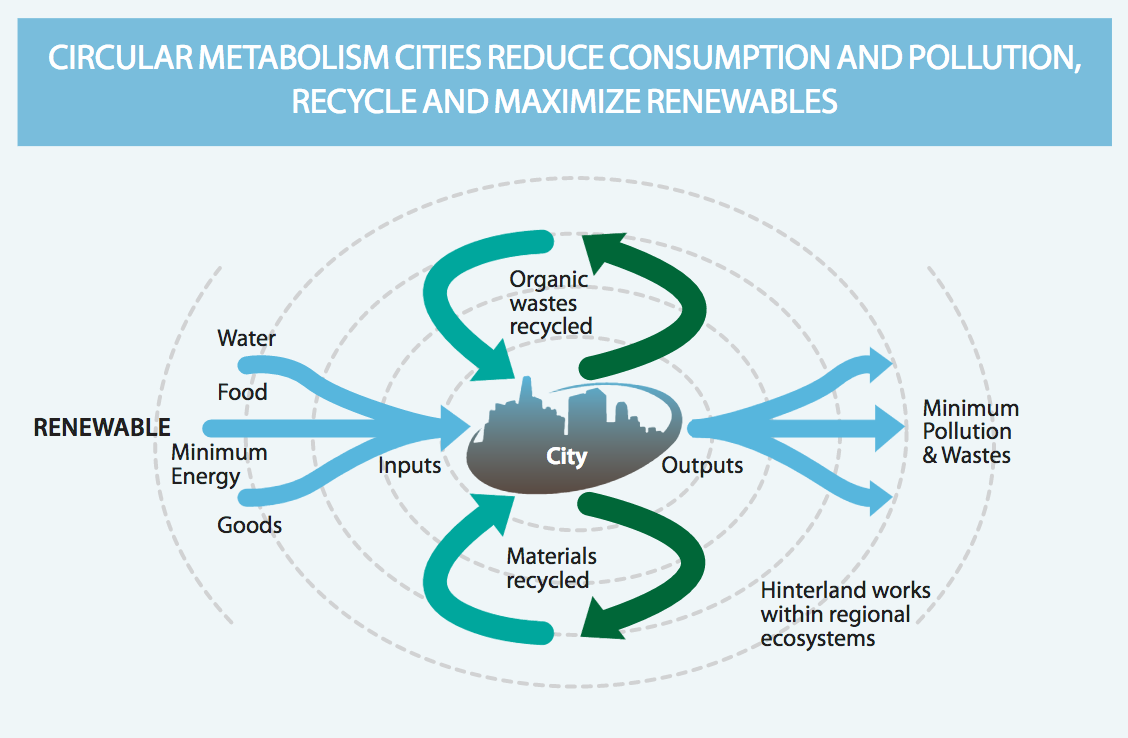
Most of our cities that we presently inhabit today have grown organically and naturally to meet market demands. This has been a linear process and indeed most of the engineering systems that serve us are simple linear processes. Input-process-output and waste. Rarely is there any real crossover of these systems or sharing of resources. For example, rarely is the city’s power plant placed near the sewage plant despite the fact that as a by-product of sewage processing methane is produced which could be used directly to generate power and heat (where needed) for the community.
Source: Herbert Girardet, “Towards the regenerative city”, World Future Council, 2013.

An alternative model that has been put forward by people such as Herbert Giradet is that we should view our cities more as holistic metabolic processes which are integrated and linked, sharing wastes and resource to maximise efficiencies and minimise waste production (and costs).

This will require a new multiprong holistic approach to the development of the city. Are our city leaders and urban planners ready?

Tuesday, 14 February 2017

Could Gandhian values offer an ideology for a more sustainable India?


South Asia and India, in particular, is heading towards a ‘perfect storm’. A deadly concoction of a serious resource crunch, an urban boom and impacts of changing climate, which could push the sub-continent over the edge.

India’s population is still growing and urbanizing with 10 million people moving into the metros each year, it is expected to be one of the largest migrations in the world. There are also a large number of people moving out of poverty and will soon have access to all of the trappings of a high energy consuming, middle-class life.

In India, like the SUV, today’s “gas-guzzling” high rise, glass buildings have become a coveted icon which we are in awe of but require much more cooling and consume many many more kWh of energy. The sale of air conditioning units is growing at 20 percent annually, with Mumbai estimated to have the same potential cooling demand as a quarter of the United States. With 80 percent of India not yet built, the expected increase in energy consumption is quickly leading to an extremely concerning environmental crisis.

By 2050, energy demand from buildings could be so large that India will need to build 900 new power stations to operate them. This level of growth in energy consumption from just one rapidly developing country will mean that we will start hurtling towards a 6 degree warmer world!
Source: Photo: Gideon Mendel/Corbis/ActionAid
The changes in climate are clearly apparent and obvious. Just last summer, we witnessed the highest recorded temperature ever in India. The Delhi Smog this winter has brought attention to the fact that NewDelhi is the most polluted city on earth right now. The great deluge of Mumbai in 2005, when almost a meter of rain fell in just one day was unnatural and damaging and the Chennai floods of 2015, exposed the failure of planners, builders, administrators and the common person to fathom the sheer power of natural events. These are but a few signs of things to come.

“Didn’t Europe have poor environmental conditions during its industrial age?”  

It is tempting to draw an analogy with the poor environmental quality during the industrial revolution in Europe and brush the environmental impacts mentioned above as growing pains that every country must go through in its journey to economic development. But there are two main differences in the context between 19th century Europe and modernising India.
The Industrial Revolution changed the relationship between humans and their environment Source: Wiki


Firstly, European nations had colonies to draw cheap resources from that allowed them to grow economically by focusing on creating manufacturing jobs and profits from exports.  India, on the other hand, is resource starved. 30 of the 35 largest cities face severe water scarcity. 14%of India uses “fossil water”, a resource which is simply irreplaceable.  Indian cities face 30hours of power outages per week. India has very little raw energy within the country to fuel our cars and charge our smartphones. The situation with construction materials is so bad that we even have a “sand mafia”. India has one of the lowest Material Footprints among large countries, an indicator of raw material availability and consumption.

Secondly, during the Industrial Revolution, Europe was home to a fraction of India’s current population and its GHG emissions, although significant in terms of accumulated “historical’ emissions, started at a time when very few countries were industrialised. The World has very little “carrying capacity” left to accommodate that level of consumption and pollution. To get a sense of scale- according to the Intergovernmental Panel on Climate Change (IPCC), to improve the possibility of keeping warming below 1.5degrees (which scientists believe is a safe global temperature goal) requires total emissions over the industrial period to be capped at no more than 2250 billion tonnes of carbon dioxide. Subtracting historical emissions from this goal requires future emissions to be lower than 400billion tonnes of carbon dioxide. If all Indians were to live like Europeans do today, additional GHG emissions from India alone will cross 500 billion tonnes by 2050.

It feels unjust and inequitable but unfortunately, there is just not enough capacity left in the world for India and other emerging markets to adopt a “western path.”

How can India ease the threat that its resource constraints pose to stability?

Gandhi: "patriotic duty of every Indian to weave his own cloth"  Image source: Wikimedia 

India had a decisive moment like this more than a century ago. To reduce the dependence on imported goods which was draining the Indian economy, India’s founding fathers chose to boycott the import of western fabric and started TheSwadeshi Movement. Every Indian was expected to spin his own cotton and weave his own cloth- self-sufficiency rather than growing dependency. A sense of pride swelled through the Indian masses as they boycotted British goods and started wearing khadi. 

Gandhihas emphasised opposite values to those of the consumer society: Could it have answers for today’s growing carbon-intensive lifestyle that would prevent us from destroying our world?

Focusing on the buildingssector, which is predicted to grow by 80% in India and could be responsible for almost half of its GHG emissions, one wonders what would our cities and buildings look like if we took Gandhi’s Swadeshi path? What if we could construct and renovate our homes, offices and communities to be more self-reliant? More practical and smart? With a homegrown philosophy that worked for India?

We have the knowledge and the technology that we need to build a better future tomorrow. Bio-climatic architecture can ensure low energy demand. Solar energy can produce most of our energy needs and through water treatment systems we can recycle our water on site for most of our water needs.

Once when, Gandhi was at Buckingham Palace, he was asked if he had felt underdressed.  His response was, “The king had enough for both of us.” He chose the traditional loincloth as a rejection of Western culture and a symbolism of self-reliance and independence from conformism.

To deal with the energy crises relating to buildings, perhaps we can apply these values and principles by producing most of the energy and water close to us as well as live within our means. It is not about making the cloth alone but needing less of it.

Could we use Gandhi’s principles to manage our consumption through awareness and self-restraint and by designing better buildings and adopting efficient technology?

It is in our control to design buildings to be slim so as to bring in light and ventilation.  We can be frugal with the amount of glass on the façade and ensure that we shade and insulate them. Through technologies such as heat pumps, we can generate hot-water at one end and cooling on the other. Can we bring back openable windows in our offices so that during the day when it is pleasant outside, people can open them? Can we reinstall ceiling fans in our workspace for when it is less pleasant so that even when turned on, an AC need not take all the load?

There are some signs that this may be happening already.

D Suresh’s house in Chennai satisfies all his needs- from growing food, using solar power, harvesting rain and generating gas for cooking using a domestic biogas plant. DineshPagaria’s house in Bangalore not only uses on-site solar power and battery banks to run the home but also used solar for the actual construction of the house. Odanthuraivillage in rural Tamil Nadu is trying to ensure that 8000 homes will receive electricity from wind and solar energy farms by leveraging the community's collective savings to obtain a bank loan to be energy independent.
Image courtesy of Ashok B Lall Architects: Mahindra Life Spaces brings affordable housing scheme to serve urban households with environmentally secure and healthy shelter


Gandhi believed that his basic message would only have its main impact many years after his own death. Had Gandhi lived in the 21st Century, he most likely would have accepted the benefits of urbanisation and the concept of the global economy, all the while expecting that we maintained our dignity and self-reliance by disrupting the ‘western’ status quo to benefit India and in turn the world. Could Gandhian values offer an ideology for a more sustainable India that may be emulated as a movement for change globally?

Monday, 11 February 2013

Transforming the housing market through green mortgages


New Affordable Housing in Medellin, Colombia
What are the three most significant factors that contribute to home property values?  The response is accompanied with a wink:  “location, location, location.” But while a home close to public transportation, good schools, and medical care should be valued higher than a relatively isolated home, its value does not reflect energy efficienciesand their resulting lower costs and environmental benefits. Sustainable homes currently do not attract favourable lending terms or result in higher property values, but the green mortgage industry has the potential to change this – as long as there is buy-in from governments, developers, banks, and home owners. 

 A green or “energy-efficient” mortgage allows the homebuyer to borrow extra money to pay for energy-efficient upgrades to an existing home or to purchase a new green home with efficiencies already in place. The home’s lower energy and water bills increase a borrower’s available net income, allowing for either a larger loan than would be otherwise possible or a discounted interest rate. Since owners of energy-efficient homes spend less per month on utility costs, they theoretically have more to spend on monthly mortgage payments.

Home buyers who are naturally motivated to purchase a green home care about the environment and/or view their newly acquired property as a status symbol. More households would be likely to invest in energy-efficient housing if there were a clear financial benefit to them, in terms of lower energy bills, higher property re-sale values, or tariff income.

Developers, on the other hand, see green homes as a way to improve their corporate image and achieve market place distinction, although the current low demand makes quicker sales elusive. Developers typically find it difficult to capitalize investments in green measures, as they are unable to transfer additional costs to the total price of the energy-efficient homes.

On the banking side, most mortgage providers have not acknowledged green homes as an ‘asset class’ and don’t provide a green mortgage product to the mass market. One of the main reasons is consumer demand is not high enough to make the product offering attractive. 

Current systems, practices, and regulatory frameworks for valuing properties and advancing loan finance do not enable consumers to place a priority on owning a sustainable home. Each of these factors influences the others, so without change of some kind, they could be self-perpetuating.[1] Ensuring that the market fully reflects the benefits of green housing is therefore vital in encouraging households to take up the measures needed to achieve emission reduction and lower fuel poverty.

There are examples of innovative thinking leading to rapid scale up. Since Mexico’s housing development agency, the Institute for the National Workers’ Housing Fund (INFONAVIT), launched its green mortgage program for low income housing in 2007, more than 600,000 green mortgages have been granted, benefiting approximately 2.4 million people. While a subsidy was provided to more than one-third of the home-buyers, once the value of green homes is better known and understood, subsidies such as that offered by INFONAVIT will no longer be needed[2]


Case Study: INFONAVIT Green Mortgage Program
    A green mortgage program was developed in 2007 by the Institute for the National Workers’ Housing Fund (INFONAVIT) in Mexico to encourage the use of energy efficient systems and technologies for low-income households.
      Families purchasing homes through INFONAVIT receive a credit of up to US$1,250 to cover the cost of eco-technologies (such as solar hot-water, low-energy lighting, water saving faucets, and thermal insulation).
      Developers are encouraged to build homes with energy-saving materials and technologies, and the low-rate mortgage enables families to save on their utility bills while paying for an increase in their monthly mortgage payment.
      INVONAVIT established that the environmental technologies installed per home should generate a minimum savings of $215.00 pesos.
      Between 2007 and 2011, more than 600,000 green mortgage credits have been granted, benefiting approximately 2.4 million people. A subsidy was provided to 38% of the homes.
      The success of this program and the continued demand for green mortgages has led to INFONAVIT to declare all their mortgages to be green.
While banks are instrumental to driving growth in the green mortgages industry, they also stand to benefit from enhancing their suite of products. Banks offering green mortgages reduce their risk by ensuring homebuyers have lower monthly bills. Green mortgages result in improved loan performance since socially-responsible homeowners tend to have better on-time payment records. Banks can also target existing customers with a good track record for retrofitted properties. Finally, banks providing green products benefit from better image branding.

In order for lenders to recognize the value of a property’s green measures, large-scale adoption of a universal green performance standard for homes is required. The standard needs to be defined by a labeling system that is inexpensive and simple, with a sharp focus on areas of cost savings. The standard needs to be supported by a well-understood calculator that can benchmark and measure energy and water savings. Both the labelling system and standard need to dovetail with a certification program that brands the property green while verifying the technical measures that have been implemented. Energy Performance Certificates in the UK are a good example of an effective labelling system but very few countries have anything close to this. 

Existing Green building rating systems are too lengthy and expensive to be adopted as a mass market system, especially for clients in developing countries. This limits the number of prospective builders/owners adopting Green Building strategies.


EDGE certified Affordable Housing in the Philippines


On the regulatory front, financial incentives must be made available to improve the energy-efficiency of homes. Central banks that refinance Housing Finance Companies (HFC) need to be persuaded, and regulatory barriers must be adjusted to allow leverage on existing subsidy thresholds (such as on the value of affordable homes).

Green homes can become a significant proportion of the housing market if supported by banks that offer green mortgages as a new asset class, with trained loan officers advising homebuyers of the merits. As awareness is raised and success stories are publicized, green mortgages will generate increased response from developers, so that more sustainable homes are offered. In this way, a circle of demand will be created that leads to greater home value, more affordability for the homeowner, and a reduced impact on the environment.

Also read Banking on Green Buildings, which discusses the value proposition for financial institutions

[1] Homes that don't cost the earth: a consultation on Scotland's Sustainable Housing Strategy, Pg. 6,
The Scottish Government, UK 2012