Showing posts with label Emerging Markets. Show all posts

Sunday, 30 May 2021

Examples of green cities financing

Elevated Metro Rail, Sukhumvit Road, Bangkok, Thailand

The ability of cities to successfully address climate change will be pivotal to limiting global warming to 1.5 degrees Celsius.

There is a desperate need and a small window of opportunity to build new climate-smart infrastructure in our cities that will enable a low carbon and resilient way of life.

When considering the additional costs of selecting low carbon, climate resilient options, it is clear that there is an immense need for urban infrastructure investment.

City budgets, as they are set up currently, will be unable to finance climate investment at the required scale. Still, cities can narrow the funding gap by using indirect financing and using policies and incentives to lure private sector financing.

Here are some practical examples of climate-smart financing instruments that cities have used around the world.

Our future and that of our planet depends on innovative financing of cities.


municipal funding sources

1

 Intergovernmental Grants

• QUEZON CITY, Philippines: LED Street Lighting Retrofit

• AMSTERDAM: Climate Adaptation Projects

2

Budget Capture (Retained Savings)

• MINSK: Energy Efficiency Upgrade Of Residential Building

• SLOVAK: EE Project  Costs Funded From General Municipal Revenues

3

Climate Tax and Carbon Pricing

• BOULDER: Funds City's Efforts On Reducing GHG Emissions

• SINGAPORE: Carbon Pricing Act and Tax

4

Land Value Capture (LVC)

• AHMEDABAD: LVC to Fund Regeneration Of Urban Land

• HONG KONG: Financing Of Transit Systems and Adjacent Real-estate Development

5

Transferable Development Rights

• MUMBAI: Funds for Metro Projects

• SAO PAULO: Funds to Finance Infrastructure

6

Property Tax Abatement

• NEW YORK: Property Tax Abatement to Properties That Use Solar Power

• CINCINNATI, Ohio: Property Tax Abatements and Exemptions to Green Certified Properties

7

Revolving Loan Funds

• SAN ANTONIO: Revolving Funds for City Efficiency Projects

• THAILAND: Revolving for Energy Efficiency Projects


municipal financing options 

8

Development Municipal Loan and Credit Lines

• BOGOTA: Finance for BRT Network

• SLOVAKIA Municipalities: Dexia Banka Credit Line for Financing Municipal Projects

9

Green Bulk Procurement and Pooled Financing 

• TAMIL NADU Municipalities: Finance for Water and Sanitation Services

• SANTIAGO: Electric-buses Bought By Utility and Leased to Operators

10

Results-based Financing and “Pay for Success” Model

• THE WEST BANK: RBF to Improve Solid Waste Management

• WASHINGTON D.C.: Finance Flood Preventing Nature Based Solutions

11

Green City Bonds

• JOHANNESBURG: Finance Renewables, Electricity From Waste Gas & Hybrid Buses

• HAWAII: Securitized Green Bonds for Consumers Loans to Fund Solar PV Panels

12

Municipal Bonds

• PUNE: General Obligation Bonds for Smart-metering Of Water Consumption

• TLALNEPANTLA DE BAZ (Mexico): Project Revenue Bonds for A Water Conservation Project

13

Reserve Fund Or Revenue Intercept

• MEXICO Municipalities: Revenue Intercept Mechanisms to Create Credit

• TAMIL NADU Municipalities: Debt Service Reserve Fund for Water and Sanitation


indirect or non-municipal city financing

14

Carbon Credits

• BUCHAREST: Pay for New Bike Lanes and Metro Improvements.

• MUMBAI: Landfill Closure

15

Establishing Carbon Markets

• TOKYO: Cap-and-trade Program to Curb Building Emissions

• BEIJING: Emissions Trading Scheme

16

Energy Service Company Model

• CHENNAI: Solar Roof-top On Municipal Buildings

• BHUBANESWAR: Upgrading and Maintaining Street Lighting System

17

Energy Performance Contracts & Efficiency-as-a-service

• EMFULENI, South Africa: Shared Saving EPC Model for Water Loss Reduction

• WASHINGTON D. C.: Pay-for-performance Model to Finance Multifamily Properties

18

Product-as-a-service (PAAS)  Or Asset Leasing

• SHENZHEN: Leasing Of Electric Buses

• GUADALAJARA, Mexico: Leased-to-own LED Street Lighting Retrofit

19

On-bill Or Property Taxed Linked Financing

• NEW YORK: Utility On-bill Recovery Loan Program (IOU)

• SAN DIEGO: Property Tax Linked PACE Program for Green Upgrades

20

Equity Fund for Private Green Firms in a City

• PARIS: Green Fund (Paris Fonds Vert) for Private Innovation for SMEs

• BOGOTA: Climate Finance Broker Facility

21

Private Public Partnerships for Cities

• BELGRADE: Availability Payments Based PPP for Waste to Energy

• VADODARA: Solar “Rent-a-roof Project” PPP

22

Incentives for Green Private Sector Investments

• SAN BORJA, Lima: High Bonus Incentive for Green Homes

• INDONESIA: Higher Loan-to-value Ratio Permit for Green Home Mortgages

23

Mobilizing Private Banks to Offer Green Finance

• COLOMBIA: Bancolombia Green Finance for Developer and Homebuyer

• INDIA: Green Car Loan


Tuesday, 7 August 2018

Green Urban Communities: Are We Ready?

Stockholm has managed to create a highly reliable bicycle system and bicycles have become part of everyday city life.
Cities can be the solution to climate change because their urban density presents a more efficient use of infrastructure and a greener way to live. As they grow, leveraging this advantage, while minimising unintended consequences of pollution and congestion is critical. The right long-term planning and investment choices made by cities now will improve people’s lives, create jobs, improve competitiveness, spur economic growth and mitigate climate change in the future.


Attractive, green urban communities located at public transit nodes can be designed anywhere in the world that combines office, residential and retail use. These mixed-use developments match density to transit capacity, rewarding city-dwellers with less expensive and more environmentally-friendly options while improving their quality of life. Experience has shown that merely providing density adjacent to public transit nodes isn’t enough--Effective policy changes such as, mandating reduced maximum car parking for homes rather than a minimum (which is unfortunately still the case in most cities in emerging markets) will also be needed to avoid perverse impacts.

Urban communities could largely power themselves and It’s possible for adoption to happen virtually overnight. More than a million gleaming solar hot water collectors now decorate the residential rooftops of Rizhao, a city of nearly three million inhabitants located in China’s Shandong province. More than 99 percent of Rizhao households power their hot water and space heating from this renewable energy source. Rizhao has cut its per capita carbon emissions by half compared to a decade ago, and its energy use by one-third.

Vauban Solar Settlement and business park in Freiberg Germany creates more energy than they consume and earn 6,000 euros per year for their residents.
Besides pushing for higher energy efficiency standards in new and existing buildings, cities can be retrofitted with fuel cell-powered cogeneration systems that generate electricity and re-purpose waste heat at the district level. By using high-efficiency, triple-effect absorption chillers, waste heat is supplied to buildings for space heating and water heating or to generate chilled water for air conditioning. Buildings that receive their energy supply from district cogeneration systems don’t require their own HVAC systems or boilers, resulting in efficiencies of up to 40 percent.


Cites in emerging markets have the potential to leapfrog the transit paradigms established in previous centuries by adopting new technologies and business models. Bus rapid transport (BRT), a term that refers to modern bus systems with dedicated traffic lanes, is a great starting point for cities to inexpensively develop a mass transit infrastructure. In Brazil, Curitiba has roughly three and a half times less car travel per person than a car-dependent city such as Brasilia, because of its extensive BRT system. With the drop in battery storage costs, buses can switch to electric to provide more efficient, green and quiet public transportation. With the astronomical rise in car ownership in cities in emerging markets (Number of vehicles in Mumbai up 50% in last 5 years), investment in BRT will have to be complemented by government policies that disincentivise car ownership. [also see my earlier post on Low Carbon Mobility]
Delhi Metro has eased some of the traffic but the city is yet to fully adjust urban planning to maximise the benefits
Most cars in cities sit idle 90 percent of the time or more, hogging space and providing little value. Urban planners can reduce parking spaces, introduce such disincentives as electronic road pricing, and place a quota on car purchases that aren’t electric. This enables alternative bike, scooter and car-sharing programs to sprout, providing a competitive array of accessible options to dart around a city. For example, the motorcycle-sharing service GO-JEK has become a crucial workaround in traffic-clogged Jakarta. Autonomous cars should be approached cautiously, as they may result in greater emissions.

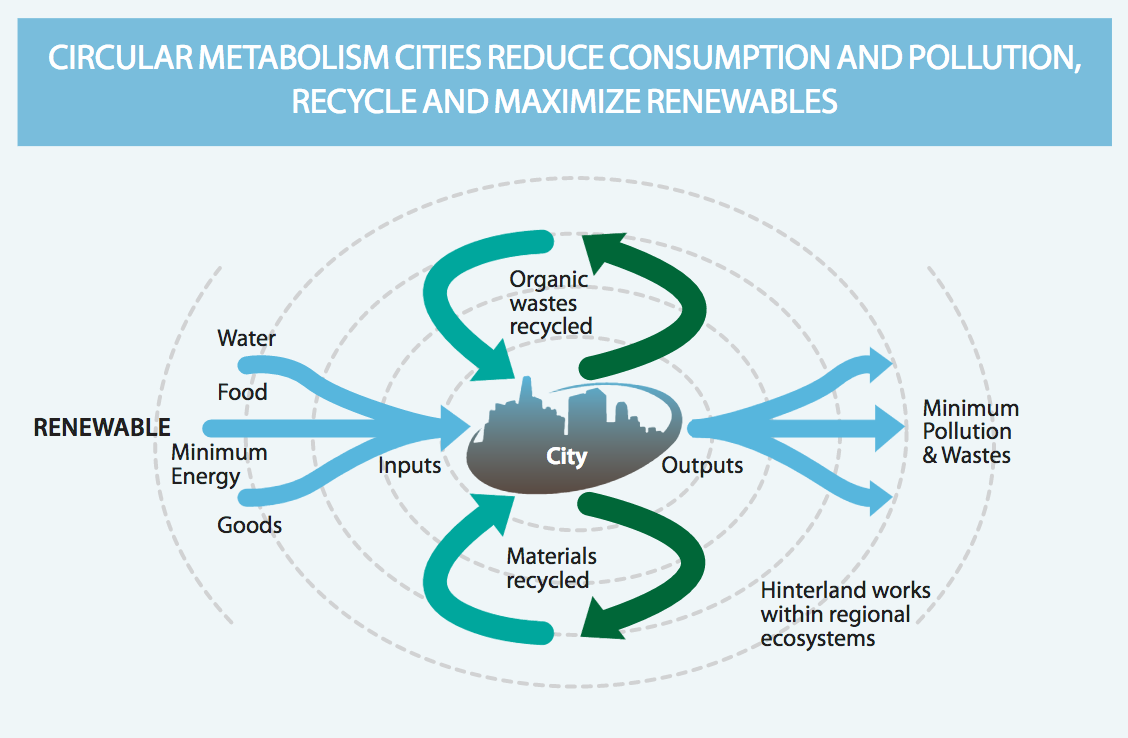
Most of our cities that we presently inhabit today have grown organically and naturally to meet market demands. This has been a linear process and indeed most of the engineering systems that serve us are simple linear processes. Input-process-output and waste. Rarely is there any real crossover of these systems or sharing of resources. For example, rarely is the city’s power plant placed near the sewage plant despite the fact that as a by-product of sewage processing methane is produced which could be used directly to generate power and heat (where needed) for the community.
Source: Herbert Girardet, “Towards the regenerative city”, World Future Council, 2013.

An alternative model that has been put forward by people such as Herbert Giradet is that we should view our cities more as holistic metabolic processes which are integrated and linked, sharing wastes and resource to maximise efficiencies and minimise waste production (and costs).

This will require a new multiprong holistic approach to the development of the city. Are our city leaders and urban planners ready?

Sunday, 5 March 2017

Dealing with the Resident Evil: Why it’s Time to Get Serious About Embodied Energy

Brick kilns dot the landscape of South Asia cities. Source:Environmental Health Perspectives

Terracotta tiles or plastic sheets? This was the decision to be made when considering roof materials for Nrityagram, a dance training center on the outskirts of Bangalore that was designed and constructed back in the early 1990s. The project marked the beginning of my interest in lifecycle environmental impacts and in understanding how to best determine the “lesser evil” among building materials.

It was clear there was something wrong with the general consensus at the time that “earthy” clay tiles and bricks were natural materials and therefore “environmentally friendly.” The tiles used up precious top soil in the surrounding villages and took excessive energy to bake them, emitting deadly polluting particles into the atmosphere.

We didn’t have the tools then to determine the best choice for materials. I was fortunate to have had a chance to work under Nigel Howard at BRE to develop ENVEST, the first software tool of its kind for estimating the lifecycle environmental impact of buildings.

Embodied energy is about the way a building is built rather than how it is used. It concerns the “upstream” value of the energy consumed by all of the processes associated with building production, from mining and the processing of natural resources straight through to manufacturing and transport. Embodied energy is the “front-end” component of the lifecycle impact of a building – and it is the part that can never be changed.

The significant impact of building materials manufacturing on the environment

Proportion of materials that get used in buildings vs. other uses. Adapted from Europa.eu
The worst culprits in building materials manufacturing are easy to determine. Five to seven percent of globalCO2 emissions are caused by cement plants. The iron and steel sector account for 11% of global CO2 emissions. And more than 5% of the world’s entire electrical generation is spent on the production of aluminum.

A lot of these manufactured materials are going towards the construction of new homes and commercial buildings due to the construction boom that is happening in the developing world, where population growth and migration to cities will contribute to doubling building stock by2050.
The environmental impact from manufacturing can be a lot more direct for some building materials. For example, the brick sector emits large volumes of black carbon and other suspended particulate matter. According to the Norwegian Institute for Air Research, brick manufacturing kilns in and around Dhaka city are responsible for 58% of the capital city's airpollution — much more than cars, power generation and other industries combined. Brick kilns are a major source of air pollution not just in Bangladesh but across South Asia and China, together accounting for 75% of the global consumption of clay bricks. More than one trillion bricks are produced annually in these countries, resulting in 1.4% of global GHG emissions. To avoid the continued compulsive use of such resource-intensive building materials, actionable change must occur.

For those who still need convincing, consider the role that iron/steel, cement and industrial electricity play in India’s carbon footprint
The above profile is broadly based on the data India submitted to the UNFCCC  through the NATCOM  


The increasing role of materials in the lifecycle impact of buildings.

Most of the focus in the building industry has been on immediate impacts. For example, how can money be saved by reducing operational energy? The reality is that as energy consumption is driven down, the relative importance of embodied energy increases. For example, while adding roof and wall insulation to an un-insulated building reduces the building’s operational energy, it also increases its embodied energy. The proportion of embodied energy compared to operational energy can jump from 10% to 15%[1]. If more and more insulation is added, the embodied energy of the insulation increases but the “return on energy” in terms of operational savings decreases[2]. As the global trend is towards tighter regulations for operational energy consumption (especially in climate zones with high heating and cooling requirements), we must consider the impact of the choices that we make when selecting building materials.

Making Informed choices is much easier than ever before

Screen shot from edgebuildings.com
At the International Finance Corporation, we created the free EDGE software to help the industry determine which building elements have the highest embodied energy – and where there are  alternatives to reduce embodied energy. For instance, in a 6000m2, five-story office block, about 55% of the building’s embodied energy is from the structural concrete slabs (roof and floor), 20% from windows, 15% from walls and the remaining 10% from flooring.

Given its high embodied energy, finding realistic ways to reduce the embodied energy of the roof and floor structure is critical if one is serious about designing a green building. Generally, these alternatives fall under four main categories:

  • Reduce the quantity of materials used (i.e., steel and concrete) by adding “filler” in slabs and/or reducing column spacing.
  • Substitute high-embodied energy materials with lower embodied energy for example, adding Pulverized Fly Ash (PFA) or Ground Granulated Blast Furnace Slag (GGBS) instead of cement to concrete.
  • Selecting a more efficient construction technology such as post-tension concrete slab or planks and joists.
  • Finding a completely different material such as timber floor construction. 

Below is a list of embodied energy values for floor slab elements which indicates there are plenty of lower impact options available compared to a typical in-situ reinforced concrete slab.
Data from EDGE Embodied Energy in Materials Methodology Report  


Options that are practical and realistic depend to a large degree on the city or country where the project is located and the materials that are available, as well as the size and scale of the building. In most cases, paying attention at the early design stage and making sensible design and specification choices can reduce the embodied energy of a five-story office building by more than one third.

Create a larger market for low embodied energy products

There are positive signs that mainstream building material manufacturers are attempting to tackle climate change impact. With companies such as Lafarge Holcim pledging to cut CO2emissions by 40% per ton of cement by 2030 we are likely to see more such commitments. The Paris Accord is driving over 200 companies to commit to Science Based Targets, surpassing expectations for corporate climate action.

Given the important role that building materials play in global resource consumption, air pollution and GHG emissions, it is essential that the measurement of embodied energy become a crucial part of the decision-making process for responsible designers and clients. Recognition must also be given to those that are responsible in their choices. Through greater awareness we will create a larger market for low-embodied-energy products and put pressure on all manufacturers to develop alternatives for their respective markets.


[1] Based on an office building in Delhi, using the EDGE software and some back-of-the-envelope calculations.
[2]  The ratio of embodied to operational energy varies by country depending on construction methods and climate zones.