Showing posts with label CHP. Show all posts

Tuesday, 7 August 2018

Green Urban Communities: Are We Ready?

Stockholm has managed to create a highly reliable bicycle system and bicycles have become part of everyday city life.
Cities can be the solution to climate change because their urban density presents a more efficient use of infrastructure and a greener way to live. As they grow, leveraging this advantage, while minimising unintended consequences of pollution and congestion is critical. The right long-term planning and investment choices made by cities now will improve people’s lives, create jobs, improve competitiveness, spur economic growth and mitigate climate change in the future.


Attractive, green urban communities located at public transit nodes can be designed anywhere in the world that combines office, residential and retail use. These mixed-use developments match density to transit capacity, rewarding city-dwellers with less expensive and more environmentally-friendly options while improving their quality of life. Experience has shown that merely providing density adjacent to public transit nodes isn’t enough--Effective policy changes such as, mandating reduced maximum car parking for homes rather than a minimum (which is unfortunately still the case in most cities in emerging markets) will also be needed to avoid perverse impacts.

Urban communities could largely power themselves and It’s possible for adoption to happen virtually overnight. More than a million gleaming solar hot water collectors now decorate the residential rooftops of Rizhao, a city of nearly three million inhabitants located in China’s Shandong province. More than 99 percent of Rizhao households power their hot water and space heating from this renewable energy source. Rizhao has cut its per capita carbon emissions by half compared to a decade ago, and its energy use by one-third.

Vauban Solar Settlement and business park in Freiberg Germany creates more energy than they consume and earn 6,000 euros per year for their residents.
Besides pushing for higher energy efficiency standards in new and existing buildings, cities can be retrofitted with fuel cell-powered cogeneration systems that generate electricity and re-purpose waste heat at the district level. By using high-efficiency, triple-effect absorption chillers, waste heat is supplied to buildings for space heating and water heating or to generate chilled water for air conditioning. Buildings that receive their energy supply from district cogeneration systems don’t require their own HVAC systems or boilers, resulting in efficiencies of up to 40 percent.


Cites in emerging markets have the potential to leapfrog the transit paradigms established in previous centuries by adopting new technologies and business models. Bus rapid transport (BRT), a term that refers to modern bus systems with dedicated traffic lanes, is a great starting point for cities to inexpensively develop a mass transit infrastructure. In Brazil, Curitiba has roughly three and a half times less car travel per person than a car-dependent city such as Brasilia, because of its extensive BRT system. With the drop in battery storage costs, buses can switch to electric to provide more efficient, green and quiet public transportation. With the astronomical rise in car ownership in cities in emerging markets (Number of vehicles in Mumbai up 50% in last 5 years), investment in BRT will have to be complemented by government policies that disincentivise car ownership. [also see my earlier post on Low Carbon Mobility]
Delhi Metro has eased some of the traffic but the city is yet to fully adjust urban planning to maximise the benefits
Most cars in cities sit idle 90 percent of the time or more, hogging space and providing little value. Urban planners can reduce parking spaces, introduce such disincentives as electronic road pricing, and place a quota on car purchases that aren’t electric. This enables alternative bike, scooter and car-sharing programs to sprout, providing a competitive array of accessible options to dart around a city. For example, the motorcycle-sharing service GO-JEK has become a crucial workaround in traffic-clogged Jakarta. Autonomous cars should be approached cautiously, as they may result in greater emissions.

Most of our cities that we presently inhabit today have grown organically and naturally to meet market demands. This has been a linear process and indeed most of the engineering systems that serve us are simple linear processes. Input-process-output and waste. Rarely is there any real crossover of these systems or sharing of resources. For example, rarely is the city’s power plant placed near the sewage plant despite the fact that as a by-product of sewage processing methane is produced which could be used directly to generate power and heat (where needed) for the community.
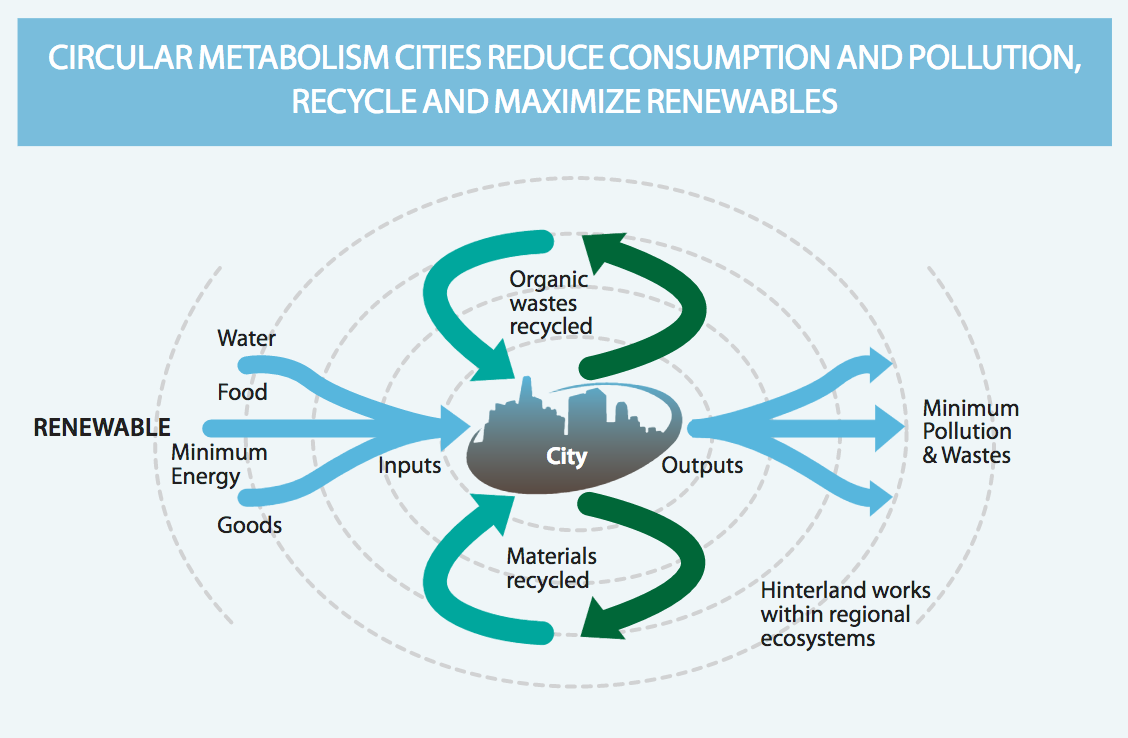
Source: Herbert Girardet, “Towards the regenerative city”, World Future Council, 2013.

An alternative model that has been put forward by people such as Herbert Giradet is that we should view our cities more as holistic metabolic processes which are integrated and linked, sharing wastes and resource to maximise efficiencies and minimise waste production (and costs).

This will require a new multiprong holistic approach to the development of the city. Are our city leaders and urban planners ready?

Thursday, 22 July 2010

CHP based district heating: a discussion

Photo by Julian Elsworth
Max Fordham Consulting Engineers have presented a case in their report- ‘A case against the widespread use of district heating and CHP in the UK’, Issue 2 / May 2010. The report provides analysis to demonstrate that CHP/district heating is not an effective low carbon solution for the UK. The report has been written in order to ascertain the best use of UK's resources and to be fair seems to be open to debate. Such transparent research and evaluation from one of UK’s leading engineering firms is not only greatly beneficial but also highly commendable in terms of the effort that has gone into it.
After many years of being in this field, I am keen to express my view on the assumptions that have been made in the report and also the broader hypothesis.
1. In the section about the carbon intensity of the grid, it is suggested that CHP/district heating should essentially be compared to CCGT rather than average fuel mix. Not sure if it is really logical when in reality 33% of UK electricity supply still uses coal [0.85kgCO2/kWh] and that is what clearly needs to be addressed when mitigating carbon emissions in this context. This argument has been made clearer by Jarek Kurnitski of Helsinki University of Technology [1].

2. The sample calculations have sized the hypothetical CHP unit to meet the monthly average electrical demand and to meet a proportion of the heating in the winter and have a surplus of heating in the summer, which is wasted. The heat deficit in winter is made up by a central gas-fired backup boiler (40% of the heat). This assumption may have substantial repercussions on the final carbon emissions. There is however, the other possibility where the CHP is sized based on heating demand. Rather than plan for one large gas turbine CHP [which is of course very efficient at generating electricity] a set of smaller modulating CHPs would be able to provide a larger proportion of the annual heating demand rather than back-up boilers. For example, a CHP unit which provides for DHW could run throughout the year and smaller machines of different sizes could be installed depending on the demand for space heating. It is doubtful that all of the electricity requirement will be met by doing this but as more of the ‘waste’ heat is used for heating the system, it becomes more efficient on the whole. The economics of having CHPs working for shorter hours [<5000hr] would however, need to be investigated.

The main aim of using CHPs is to reduce carbon emissions arising from heating rather than providing for all of the electricity demand. By sizing the CHP to meet all of the electricity demand, the proposed system within the report, under utilises the ‘waste heat’ from the CHP [even in peak winters!] therefore making it less effective.

3. The focus should also not be on homes alone as there are plenty of commercial and mixed use developments in the UK that could benefit from using CHPs. E.g., Woking Town Centre [2].


4. Heat loss of 32% has been assumed as distribution heat loss in the report. Whilst these high percentages are not unheard of, secondary research suggests that the district heating systems in Norway[3]  and Finland [4] are operating with 10% distribution losses.


Sensitivity check

The report suggests that the CHP/boiler will have an emission of 8,500tCO2 compared to 7.500tCO2 for CCGT i.e., CCGT will be 12% better.

Very quick, back of the envelope reworking suggests that:
• If the heat distribution losses are assumed as 10% rather than 32% [see issue 4], CCGT is 6% better than CHP/boiler
• If the proportion of district heat from gas back-up boilers is reduced to 20% [point 2], rather than 40% which is what the report assumes, the CHP/boiler is 4% better than CCGT.
• The above two put together will make the CHP/boiler 6% better than CCGT.
• And finally, if the district heating system is designed based on heat demand rather than electricity [issue 2- i.e., smaller capacity and with modulating units], the CHP/boiler is 13% better than CCGT. This scenario will generate 4GWh of electricity rather than 9GWh, so not all of the electricity demand of the neighbourhood would be met but the mains supply can always meet the shortfall.
• If all of the above measures are implemented then the CHP/boiler is 36% better than CCGT.

The calculations for the above discussion have been done quickly and so might be off by a few percentages. Also there is need to consider the economic implications of the proposed modulating system, added pipe insulation etc. However, 36% of lower carbon emissions instead of 12% higher, as suggested in Max Fordham’s report ‘A case against the widespread use of district heating and CHP in the UK Issue 2 / May 2010’ is a significant difference. This suggests that a more detailed sensitivity assessment (based on the right assumptions) including a cost analysis is needed and would be really useful to logically conclude this discussion.


Reference
[1] Jarek Kurnitski, Accounting CO2 emissions from electricity and district heat used in buildings www.ehpcongress.org/fileadmin/2009/presentations/tuesday/B/JKurnitski.pdf
[1] Jarek Kurnitski, Accounting CO2 emissions from electricity and district heat used in buildings www.ehpcongress.org/fileadmin/2009/presentations/tuesday/B/JKurnitski.pdf
Helsinki University of Technology.